










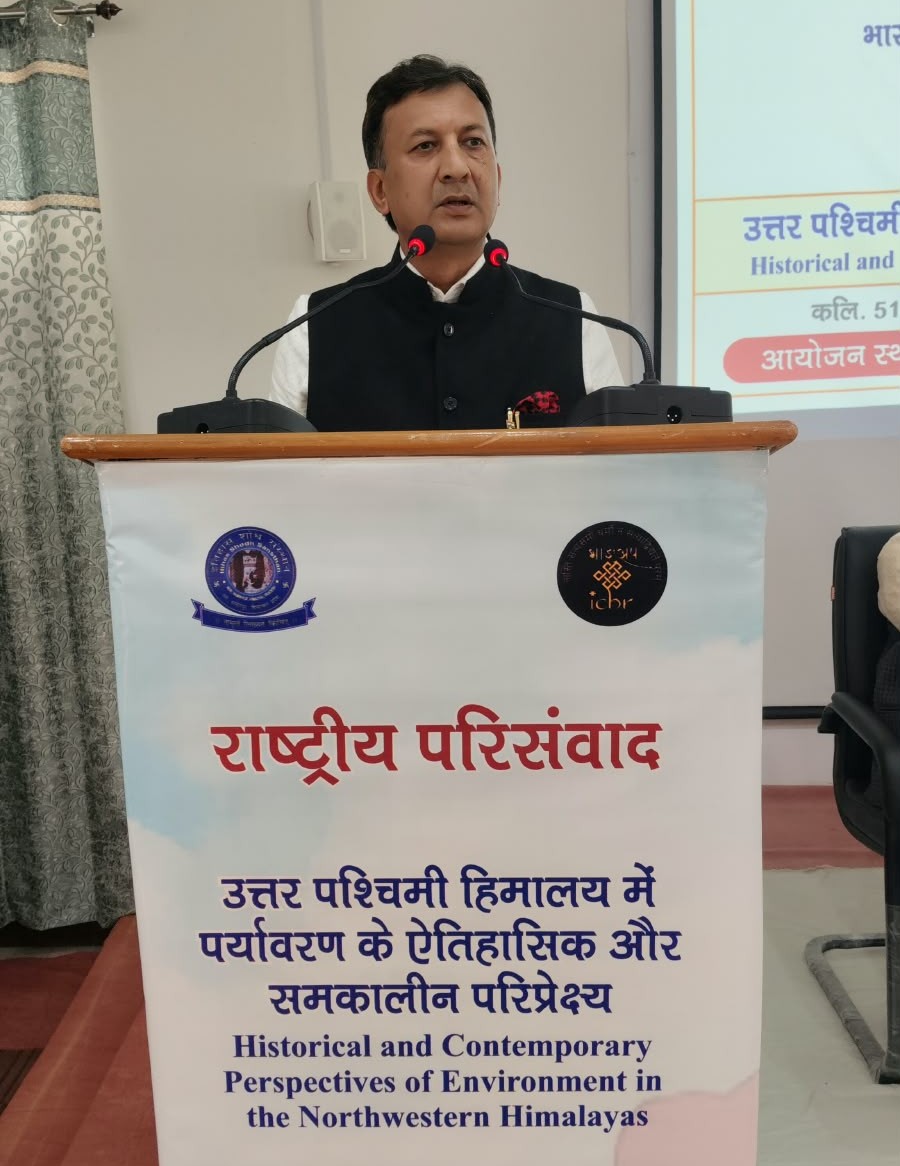
“Conserving the Himalayas is not just about protecting the mountains; it is about safeguarding the lifeline of the entire nation,” said Rajya Sabha MP Sikander Kumar while inaugurating a national symposium on ‘Historical and Contemporary Perspectives on the Environment in the North-Western Himalayas’ at the Thakur Ram Singh Itihas Shodh Sansthan, Neri, near here today.
He said the Himalayas were not merely snow-capped mountain ranges but also formed the foundation of India’s culture and economy. They were vital to the survival of millions of people in North India. He said that to avert future natural disasters, it was essential to strike a balance between the environment-friendly lifestyle of our ancestors and modern science. He added that people needed to learn from the traditional water and forest management practices of their ancestors.
The MP highlighted the significance of the Himalayas by citing historical facts and data. He said their ancestors had not exploited nature but nurtured it. The centuries-old tradition of ‘Devvan’ (sacred groves) in Himachal villages, the remarkable ‘Bawri’ (stepwell) and ‘Kuhl’ (traditional irrigation channel) systems for water conservation, and the earthquake-resistant ‘Kath-Kuni’ (timber-bonded) architecture were evidence of how deeply rooted environmental sensitivity was in traditional wisdom.
The national symposium was presided over by Prof Himanshu Chaturvedi, Director of the Indian Institute of Advanced Study, Shimla, and Prof Suryavanshi Saraswat, Director of the National Institute of Technology, Hamirpur. Environmentalist Kulbhushan Upmanyu was also present.